Teach with real imaging cases, online or on site

Build a library of full DICOM cases, present with polls, and share a link for self-study.


  • Collective Minds Teaching
Research-Pipeline-Monitor XDR
Research- Results table

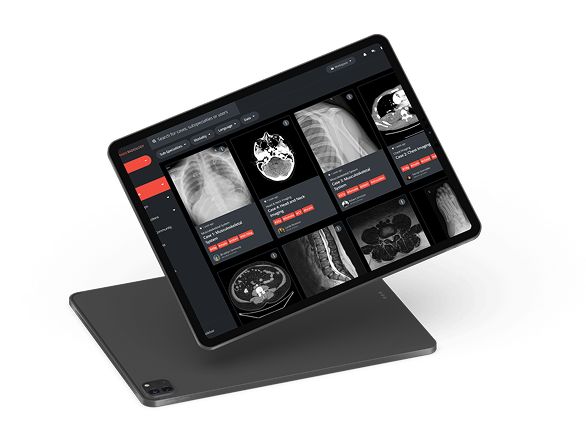
Imaging is learned on real cases that students can scroll, measure and discuss. Slides lose that, and a hospital PACS is not built for sharing cases with learners outside the department. Collective Minds Teaching gives educators a library of full DICOM cases that are pseudonymized on upload.

Research-Pipeline-on tablet

How it works


  • Upload the cases. Drag full DICOM cases into the web uploader. They are pseudonymized on upload.
  • Build a library. Keep a shared library for a teaching group or a private one. Group cases into Collections with background, diagnosis, PDFs, images or videos.
  • Teach live. Present in class, in a webinar or in a hybrid session. Mix cases with your slides, reveal the diagnosis when you choose and run polls.
  • Share for self-study. Send a link, password protected if you want, so learners review the cases on their own.
  • Reuse. Update a Collection and use it again with the next cohort.

What changes

  • Real cases, not screenshots. Learners work on full DICOM cases.
  • A library that stays with you. Cases and folders can be updated and reused.
  • Answers in real time. Polls show what the group understood.

Projects like this

A radiology college’s annual meeting, online

A national radiology college wanted to teach at its annual meeting online, with every attendee opening the same cases.
What we did: lectures, cases and registration in one Teaching workspace, with up to 400 radiologists reviewing large studies at once in a live session.
Result: more than 1 200 participants this year, about four times as many as before.

Exam preparation for pediatric neuroradiology fellows

More than 70 fellows worldwide had no easy access to a curated set of cases.
What we did: educators contributed cases, and ten seminars of ten cases each were shared through password-protected links. Fellows reviewed and reported each case for their supervisor.
Result: self-directed, web-based learning with collections that can be updated and reused.

A radiography program

An undergraduate and postgraduate program with 589 enrolled students taught with PowerPoint.
What we did: case-based teaching with growing collections of cases and quizzes.
Result: the program reports improved attendance, test results and engagement.

Remote consultation and teaching in Africa

A charity supporting hospitals in Ghana, The Gambia and Malawi.
What we did: remote consultation and teaching on shared cases, 1,000 cases to date.
Result: a user survey found that patient management changed in 75% of discussed cases in Ghana and 70% in The Gambia.

Questions we hear

Is Teaching for students or for educators?

For educators. Educators build the library and learners open the cases an educator shares.

Can I use my own hospital cases?

Yes. Upload them and they are pseudonymized on upload. Your data protection team should confirm the setup.

Can I mix my slides with the cases?

Yes. A Seminar combines cases and slides, and you can hide the slides you do not want to show.

Do learners need to install anything?

No. They open the link in a web browser.

Teaching with imaging?

Tell us about your course and we will show you how it would run.
ipad