A multi-site imaging study lives or dies on how easily researchers can exchange images. Burning discs, emailing zip files, or asking each site to upload to a different shared drive makes studies slow, hard to audit, and risky for patient privacy. Radiology image sharing platforms built for research solve this by letting investigators at different institutions work on the same de-identified imaging data, with the right access for each person. This guide explains how sharing works for clinical trials and for academic research, and what to check on access, login, and security.
What Is Radiology Image Sharing for Research?
For research, image sharing means that studies leave the hospital already de-identified, arrive in one central project, and are visible only to the people who need them. Sponsors, CROs, sites, and readers can all work on the same data without passing files around.
It is a different job from moving images between care providers. Researchers need pseudonymization before transfer, project-level permissions, reader workflows, and a complete audit trail. For how a research platform differs from a PACS, read Medical Imaging Platform vs. PACS.
Sharing Imaging Data in Clinical Trials
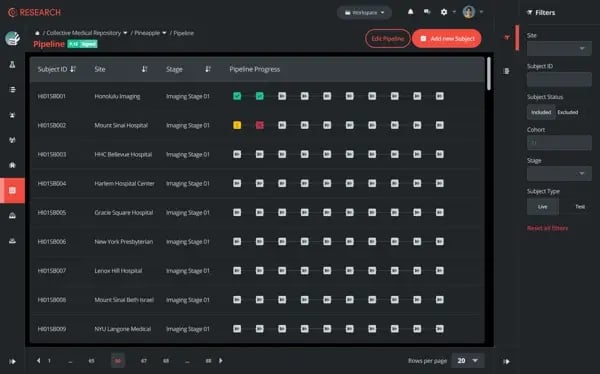
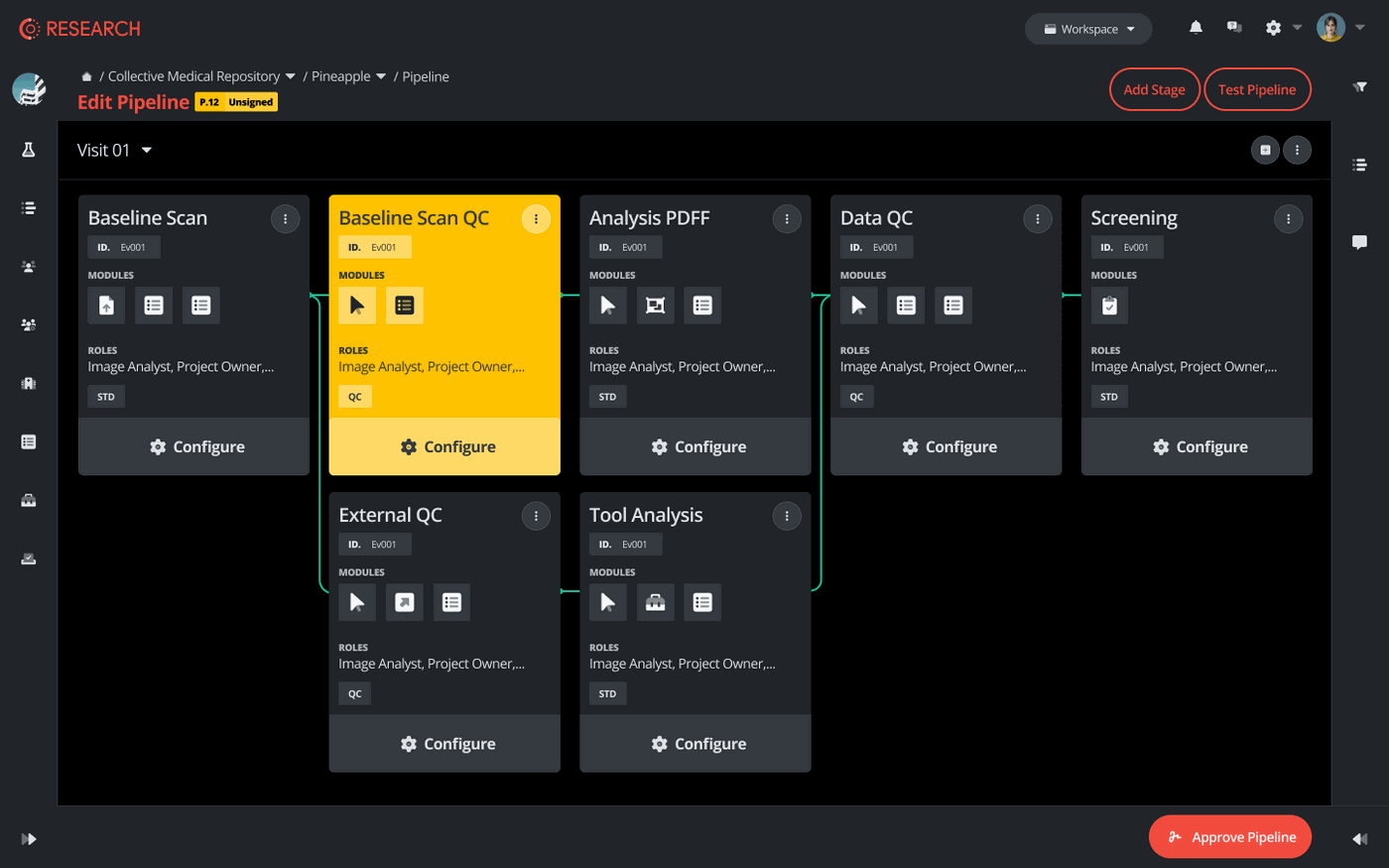
In a clinical trial, imaging data flows between many parties: hospital sites, one or more CROs, central readers, and the sponsor. Collective Minds Research, a GCP-compliant medical imaging research platform, brings them into one place with role-based access for sponsors, CROs, and sites, so each party sees only what they should.
- Sponsor visibility: sponsors can be given role-based access to results tables, audit logs, and pipeline overviews, with visibility across all sites and CROs, which matters when a trial is split between several CROs.
- Separate projects: every project has its own permissions, pipeline, and audit trail, and users only see the projects they have been granted access to.
- Reader tracking: reader activity is tracked and documented to support GCP oversight.
- Any phase: the same setup scales from Phase I to Phase IV, so infrastructure and audit trails carry forward without migration.
This is the setup used by biotech, pharma, and medtech sponsors. See the pages for biopharma, biotech and medtech, and CROs, or the Clinical Trial Imaging Platform.

Sharing Imaging Data in Academic Research
Academic groups share imaging data for investigator-initiated studies, multicenter consortia, and institutional repositories. The needs are similar, with fewer central roles and more collaborators from outside the institution.
On Collective Minds, external collaborators are invited as named users with role-based permissions, and the project admin can revoke access at any time. All sharing activity is logged. More than 300 institutions are connected to the platform, and the controls are aligned with the requirements commonly set by IRBs and ethics committees. Documentation of certifications and data handling practices is available for ethics submissions. Learn more on the hospitals and academia page.

Clinical Trial Imaging Data Transfer: From Hospital to Platform
Sharing starts at the site. Collective Minds Connect is a DICOM gateway, a secure edge gateway installed at the hospital that replaces the manual export, de-identification, and upload of DICOM files. It receives studies pushed from the PACS or scanner, manually or automatically, and de-identifies, anonymizes, or pseudonymizes them under user-defined rules, including removal of burned-in annotations, before they are encrypted and sent to the project.
Connect works with any PACS that can add another destination node, and it needs no inbound firewall ports. Sites without a gateway can use web upload, or premium sFTP for bulk transfer.

Access Control and Login
Who can see what is the heart of safe research sharing. The platform controls access in three layers.
- Project roles: each project member gets a role such as Admin, Editor, or Viewer, set per project, and site affiliations show which institution each member belongs to.
- Named invitations: collaborators from any institution are invited by email address, and access can be revoked at any time.
- Single sign-on: users can sign in with their own hospital or university identity provider through OIDC or SAML.
Every access is logged, and data stays separated between studies. Data is pseudonymized for collaborators while remaining traceable on the sponsor side.
Security and Compliance
Imaging studies contain protected health information, so the strongest safeguard is to remove identity at the source and never store personal sensitive information in the platform.
- Pseudonymization before transfer: done locally by Connect, before data leaves the hospital.
- Certified information security: the information security management system is certified to ISO/IEC 27001:2022 by A-LIGN.
- Hosting: AWS servers in Frankfurt, with replication across multiple availability zones. AWS holds ISO 27001, 27017, 27018, and SOC 1, 2, and 3 attestations.
- Regulatory alignment: Research adheres to 21 CFR Part 11, GxP and GCP, ALCOA+ principles, and ISPE GAMP guidelines.
- Full audit trail: every action is logged, signed, and timestamped, which supports submission-ready audit trails.
- GDPR role: Collective Minds acts as a data processor, and a signed MSA and DPA are required before collaboration starts.
For compliance in trials, see our guide to clinical trial imaging compliance. To remove sensitive pixel data before sharing, use the Collective Minds DICOM Anonymizer.
How to Choose a Research Image Sharing Platform
Use these questions to compare platforms.
- Where does de-identification happen? Prefer before data leaves the site.
- How granular is access? Look for per-project roles, named invitations, and revocation.
- How do users sign in? Check for single sign-on with institutional identity providers.
- What can you prove? Audit trails, certifications, and regulatory alignment for your study.
- Who runs it? Compare a managed service against software you host and validate yourself.
Other research imaging platforms worth comparing include Flywheel, QMENTA, and the open source XNAT. For the wider workflow, read how to centralize medical imaging data for multi-site studies.
Things You Might Be Wondering
How does clinical trial DICOM transfer work between sites?
Each site installs a DICOM gateway that receives studies from the PACS or scanner, pseudonymizes them under the trial rules, and sends them encrypted to the central project. This removes manual exports and uploads and keeps transfers logged.
How do researchers share imaging data between institutions securely?
Sites send studies from their PACS or scanner to a gateway that pseudonymizes them under study rules and forwards them, encrypted, to a central project. Collaborators then access the data through role-based permissions, and every action is logged.
How do external collaborators get access?
They are invited by email as named users with a role, and a project admin can revoke access at any time. Collaborators from any institution can be added with their site affiliation.
Does the platform support single sign-on?
Yes. Collective Minds supports single sign-on through OIDC or SAML with hospital or university identity providers.
Can we use it for investigator-initiated studies and consortia?
Yes. Hospitals and universities use it for investigator-initiated studies and multicenter consortia, as well as for clinical trials with CROs and sponsors.
How is patient privacy protected?
Data is pseudonymized or anonymized before it leaves the hospital, and personal sensitive information is not stored on Collective Minds. Access is role-based and logged.
Does it replace our PACS?
No. It works alongside the PACS. Collective Minds works with any PACS that can add another destination node, so it fits your existing infrastructure.
What agreements are needed before collaborating?
A signed Master Services Agreement and Data Processing Agreement are required before collaboration starts.
Reviewed by: Pilar Flores on October 16, 2026
.png?width=1024&height=1024&name=Edit%20Pipeline-Galaxy%20Tab%20S8%20Ultra%20(2).png)