
Medical imaging already accounts for an estimated 30% of all healthcare data generated worldwide, with total volumes projected to exceed 2,000 exabytes. Most clinical research teams do not lack imaging data. They lack a strategy for it. Images arrive from dozens of sites, in different formats, with inconsistent metadata, and get stored wherever was convenient at the time, until someone needs to reuse that data for a new analysis, a regulatory submission, or a future study, and discovers how much work it takes to make it usable. A medical imaging strategy is what prevents that scramble by deciding, in advance, how imaging data will be acquired, managed, and reused across the full research lifecycle.
The teams that feel this gap most acutely are usually not running their first imaging trial. They are the ones trying to reuse data from a previous study, or trying to scale a process that worked fine at five sites but is starting to strain at twenty, and realizing that what got them this far was improvisation rather than a strategy that was ever written down.
Core components of a research-ready medical imaging strategy
A strategy is more than a single tool or vendor choice. It is a set of decisions, made before data collection starts, about each of the following components. None of them are optional in isolation. Skipping one tends to create work for the others. A gap in metadata quality, for example, makes de-identification harder to verify and audit trails harder to trust.
1. Standardized acquisition guidelines across sites
Every site involved in a study needs the same documented acquisition guidelines, covering scanner settings, positioning, contrast protocols, and sequence parameters. Sites also need to be qualified against those guidelines before they enroll a single patient. Skip that step, and comparing imaging data across sites becomes an exercise in guessing whether the differences are clinical or just methodological.
Guidelines also need version control. When a protocol is amended mid-study, every site needs to move to the new version at the same time, with a clear record of which version applied to each patient's imaging.
Writing guidelines that are specific enough to be checkable matters more than writing guidelines that are thorough. A one-page checklist a site can be audited against is more useful in practice than a lengthy document that describes best practice in general terms without a verifiable standard behind it.
2. Site onboarding and submission workflows
A strategy needs a defined process for bringing a new site online: training, qualification, and a single, consistent way to submit imaging data once the site is active. Sites left to improvise their own submission process are the most common source of the inconsistency a strategy is meant to prevent.
Onboarding should be fast enough that it does not become a bottleneck to site activation, but thorough enough that a site cannot start scanning patients before it is properly qualified. Balancing those two pressures is one of the more practical challenges in executing a strategy rather than just writing one.
A repeatable onboarding checklist, rather than an ad hoc conversation with each new site, is what makes this scale. Trials that add sites throughout enrollment, rather than activating all of them at once, benefit most from having this process defined once rather than reinvented for every new site.
3. De-identification and pseudonymization controls
Protecting patient privacy in imaging data needs to be a designed control, not a manual habit. A strategy specifies exactly which fields and pixel regions get de-identified, how pseudonymization codes are generated and managed, and how that process is applied consistently regardless of which site or system the data originated from.
This is also where a strategy has to account for modality-specific risk. Head and neck imaging can carry identifying facial information in the pixel data itself. Header-only de-identification will miss that, so the strategy needs to specify additional controls for the modalities where the risk applies.
Consistency across sites matters as much as thoroughness at any single site. A strategy that lets each site interpret de-identification requirements independently will produce a dataset with uneven privacy protection. That is a compliance problem, even if every individual site technically followed some version of the rules.
Also Read: DICOM Anonymizer: Safeguarding Patient Privacy in Medical Imaging
4. Metadata quality and data standardization
Metadata is what makes imaging data searchable, comparable, and usable years after it was collected. A strategy defines which metadata fields are mandatory, how inconsistent vendor-specific values get normalized, and what happens when a study arrives with missing or malformed metadata. The FAIR principles, that data should be Findable, Accessible, Interoperable, and Reusable, are a practical checklist for what that standardization should actually achieve, rather than an abstract framework to reference and forget.
Standardization pays off most visibly when data needs to be reused, whether for a secondary analysis, a new AI model, or a future study using the same repository. Data with consistent, complete metadata can be filtered and reused in hours. Data without it can take months to reconstruct.
Metadata standards also need to be enforced at intake, not corrected later. A validation step that rejects or flags incomplete metadata as data arrives is far more effective than a periodic cleanup project applied to an archive that has already grown large and inconsistent.
5. Centralized imaging repository
A strategy needs a single system of record for imaging data, rather than a mix of local PACS systems, shared drives, and vendor-specific portals. Centralization is what makes every other component of the strategy actually enforceable across every site: quality control, review routing, audit logging, all of it.
This is also where centralization earns its keep against an alternative some teams consider: federated approaches that leave data distributed across each site's own infrastructure. Federated models can look appealing on paper, but they push the burden of security, versioning, and quality control onto every individual site instead of solving it once. For a closer look at where that tradeoff breaks down in practice, see The 5 Hidden Truths About Federated Learning in Medical AI.
Centralizing storage does not mean every user needs the same access. A well-designed repository supports role-based access so sites, readers, monitors, and sponsors each see exactly the data relevant to their role, without duplicating the underlying dataset.
A repository built for one study should also be able to outlive it. Structuring storage so that a completed trial's imaging data remains organized and searchable, rather than archived into an unstructured backup, is what makes future reuse realistic instead of theoretical.
6. Image quality control before review
Quality checks against the acquisition protocol should happen as data enters the repository, not after it has already reached a reader. Catching a deviation at intake, while the patient may still be available for a rescan, is far more valuable operationally than catching it during central review.
A strategy should define what happens when a study fails quality control: who gets queried, what the expected turnaround is, and how the resolution gets documented. Without these rules, QC failures tend to sit unresolved longer than they should.
QC data is also useful beyond the individual study. Tracking failure patterns by site over time gives a study team an early, objective signal about which sites need retraining, well before that shows up as a bigger problem in central review.
7. Reader management and BICR-ready workflows
For trials that depend on independent image review, a strategy needs defined rules for reader qualification, blinding, assignment, and adjudication. This is what makes blinded independent central review, BICR, executable consistently rather than reinvented for each study.
Reader management also needs to account for scale. A strategy built around a single reader working through a spreadsheet queue will not hold up once a study needs a dozen readers working in parallel across multiple time zones.
Tracking reader agreement over time, not just at study close, also lets a team catch drift early. Left alone, that drift accumulates into a larger discrepancy that has to be resolved retrospectively.
8. Audit trails and GCP-compliant documentation
Every action taken on an image, from acquisition through final review, needs a timestamped record tied to a user. This is the component of a strategy that regulators and auditors engage with most directly. It is what turns a claim about how data was handled into something demonstrable, and it is explicitly called out in the FDA's Clinical Trial Imaging Endpoint Process Standards guidance, which expects a verifiable record of the imaging process for any trial using imaging as a primary endpoint.
A strategy that treats audit logging as a byproduct of the workflow, generated automatically as data moves through it, holds up far better under inspection. The alternative, reconstructing a timeline from emails and spreadsheets after the fact, rarely holds up at all.
A useful test for any strategy is whether a team could produce a complete acquisition-to-review timeline for a single, randomly chosen patient within minutes. If that requires cross-referencing several disconnected systems, the audit trail component of the strategy is not yet doing its job.
9. Data export and integration with clinical trial systems
Imaging data eventually needs to connect to the rest of a trial's data: the EDC, the clinical database, and any lab or biomarker data collected alongside it. A strategy should specify shared patient and visit identifiers and a defined export process, decided early rather than reconciled manually once both systems are already in production.
This component is often owned by a different team than the rest of the strategy: imaging operations on one side, clinical data management on the other. That split is exactly why it needs to be decided explicitly, not assumed. Two teams each assuming the other has handled identifier alignment is a common way this gap goes unnoticed until analysis time.
Also Read: Medical Imaging Workflow: Optimize Clinical Trial Success

Build the imaging data strategy for reuse beyond the trial endpoint
A good imaging strategy pays for itself once, at the endpoint the trial was designed around. A great one keeps paying for itself afterward, when that same data supports a secondary analysis, a regulatory submission for a related indication, or training data for a new AI model. The difference between the two is almost always metadata quality and de-identification consistency, decided during the original strategy rather than retrofitted years later when someone finally tries to reuse the archive.
Reuse also depends on documentation that travels with the data rather than living in someone's memory. A dataset with clear records of consent scope, de-identification method, and acquisition protocol can be evaluated for a new use case quickly. A dataset without that documentation often cannot be reused at all, regardless of how clinically valuable the underlying images are, simply because no one can confirm what is and is not permitted.
This is worth planning for even when a second use case is not yet defined. Consent language and data governance decisions made at the start of a study are far harder to change retroactively than they are to get right the first time. That makes this one of the few strategy decisions that genuinely cannot be deferred.
Imaging strategy for multi-center and multi-modal clinical research
Multi-center trials multiply every risk a strategy is meant to control. Inconsistency at even one site can compromise comparability across the whole study. Multi-modal trials add a second axis of complexity, combining CT, MRI, PET, or other modalities, each with its own acquisition and quality considerations. A strategy built for a single-site, single-modality study rarely scales cleanly to this setting without significant rework. That is why it is worth designing for the more demanding case from the start, even if the first study using it is comparatively simple.
Academic and consortium research adds a further layer. Imaging repositories built to serve multiple studies over time need governance decisions, who can request access, under what conditions, that a single-study strategy does not need to address. Designing for this case early avoids having to renegotiate data governance after a repository already has active users depending on it.
MedTech and device trials add their own variation. Imaging endpoints there often support a regulatory submission directly rather than a broader research question, which raises the bar on documentation and traceability, even for what might otherwise be a smaller, single-modality study.
Where Collective Minds fits into a clinical research imaging strategy
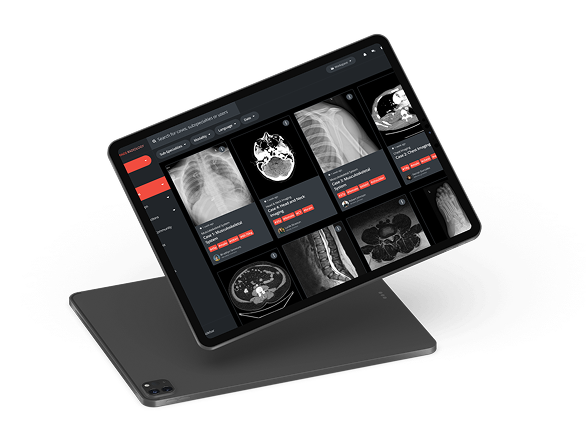
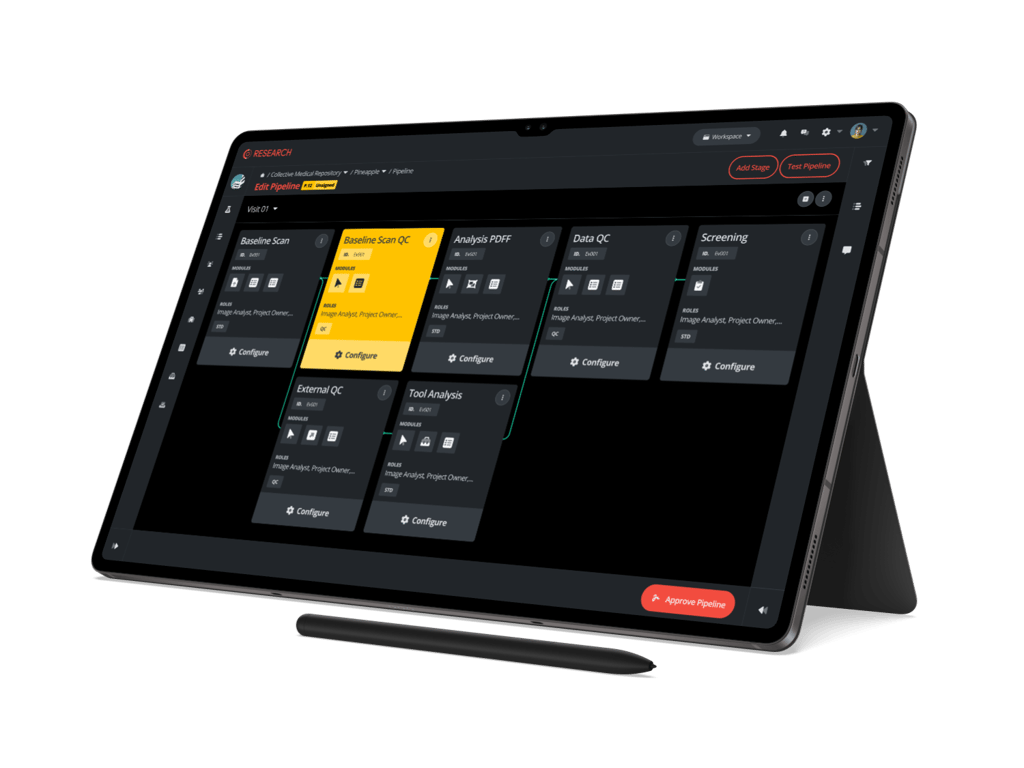
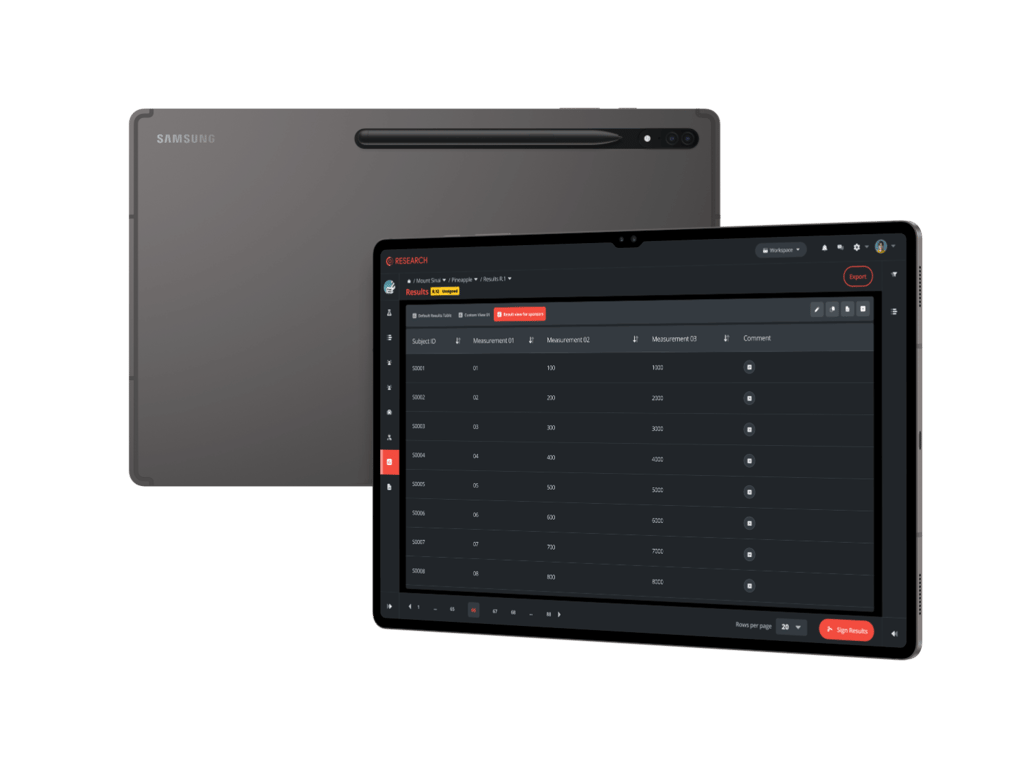
The Collective Minds Research platform is built to operationalize the components described above: standardized acquisition and site onboarding, configurable de-identification, centralized storage with role-based access, quality control at intake, structured reader and adjudication workflows, and a connected audit trail spanning the full imaging lifecycle. Teams do not need to build this infrastructure themselves to execute a strategy consistently across sites, studies, and years.
Because the platform handles these components consistently across every study a team runs, a strategy defined once can be reused study after study rather than reinvented from scratch each time. That reuse is where most of the long-term value of having a real strategy, rather than a set of ad hoc decisions, actually shows up.
Also Read: Clinical Trial Imaging in Medical Research
An effective imaging strategy turns clinical images into research-ready evidence
A medical imaging strategy is the difference between imaging data that has to be reconstructed and cleaned up every time someone needs it, and imaging data that is ready to use the moment a new question comes up. Teams that invest in the components above before data collection starts spend far less time later fighting their own archive, and get far more long-term value out of every image they collect.
None of the nine components described in this guide are exotic. Most research teams already do some version of several of them. The teams that get the most value out of their imaging data are the ones that treat all nine as one connected strategy, decided deliberately, rather than as separate operational details each handled by whichever team happens to own that part of the workflow.
Reviewed by: Pär Kragsterman on July 3, 2026