A trial protocol can specify the right imaging endpoint, the right modality, and the right reading paradigm, and still run into trouble once real sites, real scanners, and real patients are involved. Medical imaging adds a layer of operational and scientific complexity that most clinical data does not carry, and the trials that struggle with it are rarely dealing with one big problem. They are usually dealing with several smaller ones that compound.
This matters more as imaging endpoints become more central to how new therapies are evaluated, particularly in oncology, neurology, and medical device trials. The ten challenges below cover the full imaging lifecycle, from how an endpoint is chosen through how the resulting data ends up in a regulatory submission, and each one is a place where a trial can lose time, lose data, or lose confidence in its own results.
Why medical imaging is difficult to manage in clinical trials
Unlike a lab value or a questionnaire score, an image is not a single number. It is acquired differently depending on the scanner, the technician, and the site's protocol adherence, and it has to be interpreted by a human reader before it becomes usable data. Every one of those steps introduces variability that a sponsor has to control for, across dozens of sites that may span multiple countries and regulatory regimes.
That variability compounds rather than averages out. A small acquisition inconsistency at one site, combined with a reader who interprets borderline findings slightly differently, combined with a data pipeline that reconciles imaging and clinical data manually, does not produce three small problems. It produces one dataset that is hard to trust and expensive to clean up, usually discovered well after the sites involved have moved on to other studies.
The challenges below are the ones that show up most often, and most of them trace back to the same root cause: imaging was treated as a downstream data source instead of a workstream that needed its own plan, its own quality checks, and its own infrastructure from the start of the trial.
10 medical imaging challenges in clinical trials
1. Imaging endpoints that do not clearly reflect clinical outcomes
An imaging endpoint is only useful if it actually correlates with how a patient is doing. When an endpoint is chosen mainly because it is measurable rather than because it is clinically meaningful, sponsors end up with clean data that regulators and clinicians are not convinced tells the whole story. Getting this right requires imaging and clinical teams to agree on the endpoint's rationale before the protocol is finalized, not after the first interim analysis raises questions.
This is especially common when a novel imaging biomarker is adopted from academic literature without validating that it behaves consistently across the multi-site, multi-scanner setting a trial actually runs in. A biomarker that looked clean in a single-center study can become noisy the moment ten sites and three scanner vendors are added, and that noise can be mistaken for a treatment effect, or mask one, if it is not accounted for during analysis.
2. Complex response criteria that are hard for sites to operationalize
Frameworks like RECIST, iRECIST, or RANO are precise on paper, but applying them consistently requires training and judgment calls that sites do not always have the bandwidth for. A site technician or local radiologist under time pressure can apply a response criterion slightly differently than the reader charter intends, and that drift is often invisible until central review catches it, sometimes only for a subset of sites.
Reader training at study start helps, but criteria interpretation can still drift over a multi-year trial as staff turn over at sites. Refresher training and periodic calibration checks against a shared set of reference images are what keep interpretation consistent from the first patient enrolled to the last.
3. Imaging plans that overburden patients or sites
It is tempting to add "just one more scan" to capture additional exploratory data, but every added imaging visit increases patient burden, site workload, and the risk of missed or incomplete studies. Imaging plans that are not stress-tested against a site's real capacity tend to produce more protocol deviations, not more data.
Patient burden matters clinically as well as operationally: a patient who finds an imaging schedule too demanding is more likely to withdraw or miss visits, which shows up later as missing data that is far harder to explain to a regulator than a slightly smaller exploratory dataset would have been.
4. Inconsistent image acquisition across sites, scanners, and vendors
A multi-site trial can involve a dozen scanner models across several manufacturers, each with its own default settings. Without a detailed imaging manual and site qualification process, acquisition parameters drift from site to site, which makes it harder to compare images later and can disqualify scans from analysis entirely.
Site qualification before enrollment, phantom scans to verify a scanner meets protocol requirements, and periodic re-qualification after a site upgrades its equipment are what keep acquisition consistent for the life of a trial rather than just at study start.
5. Image quality problems that are caught too late
When quality control happens only at the point of central review, a bad scan is discovered weeks after the patient has left the clinic, when a rescan may no longer be possible. The later a quality issue is caught, the more expensive it is to fix, and the more likely it becomes a permanent gap in the dataset rather than a quick correction.
Moving quality checks to the moment a study arrives, rather than waiting for a reader to open it, is the single change that prevents the most late-stage data loss. A study flagged the same day it is uploaded can often be corrected while the patient is still available for a rescan.
6. Fragmented upload, transfer, and query workflows
Sites emailing images, uploading to inconsistent portals, or shipping physical media create a patchwork of transfer methods that is hard to monitor and easy to lose track of. When a study is missing or incomplete, a fragmented workflow makes it harder to even identify where in the process it went wrong.
A single, standardized transfer channel does not just simplify the site's job. It gives the study team one place to look when something is missing, instead of having to check email, a portal, and a shipping log to figure out where a given patient's imaging visit stands.
7. Reader variability in image interpretation and measurement
Two experienced readers can look at the same scan and record different measurements or a different overall assessment, particularly for subtle findings. This is normal, expected, and exactly why blinded independent central review with multiple readers exists, but it also means reader variability has to be actively managed rather than assumed away.
Tracking agreement rates between readers over the course of a study, not just at the end, makes it possible to catch a reader who is drifting from the reference standard early enough to retrain them rather than discovering the problem during database lock, when correcting it would mean re-reading a large batch of studies under time pressure.
8. Adjudication workflows that slow down trial timelines
When two readers disagree, a third reader has to adjudicate, and if that workflow is not well defined and automated, disagreements can sit in a queue for weeks. In trials with tight timelines, a slow adjudication process becomes one of the biggest sources of delay between last scan and database lock.
Automated routing to a pre-assigned adjudicator, with a defined turnaround time, keeps disagreements from accumulating into a backlog. Without that structure, adjudication tends to happen in batches right before a milestone, which is the worst possible time for a queue to be long.
9. Imaging data that does not connect cleanly with clinical trial data
Imaging findings need to line up with the clinical data collected in the EDC, but imaging systems and clinical data systems are often built separately and do not share a common patient or visit identifier by default. Reconciling the two after the fact is slow and error-prone, and it is usually where a statistician first discovers a data quality problem.
Aligning patient and visit identifiers between the imaging platform and the EDC from the start of the study avoids a manual reconciliation exercise later. Retrofitting that alignment after hundreds of studies have already been collected is far more work than defining it in the data management plan up front, and it is a common cause of last-minute data cleaning right before database lock.
10. AI tools that are hard to validate, explain, and integrate safely
AI-assisted analysis can speed up measurement and flag findings a reader might miss, but sponsors and regulators reasonably want to know how a given AI tool was validated, on what data, and how its output is checked before it becomes part of the trial record. Tools that cannot explain their output, or that were validated on a population that does not resemble the trial's patients, create more regulatory risk than they remove workload.
The safest way to introduce AI into an imaging workflow is as a second opinion the reader can accept, adjust, or reject, with that decision logged. That keeps the human reader accountable for the final measurement while still capturing the speed benefit AI is meant to provide, and it gives sponsors a clear answer when a regulator asks how a specific AI-assisted measurement was arrived at.
How Collective Minds helps clinical trial teams manage imaging challenges
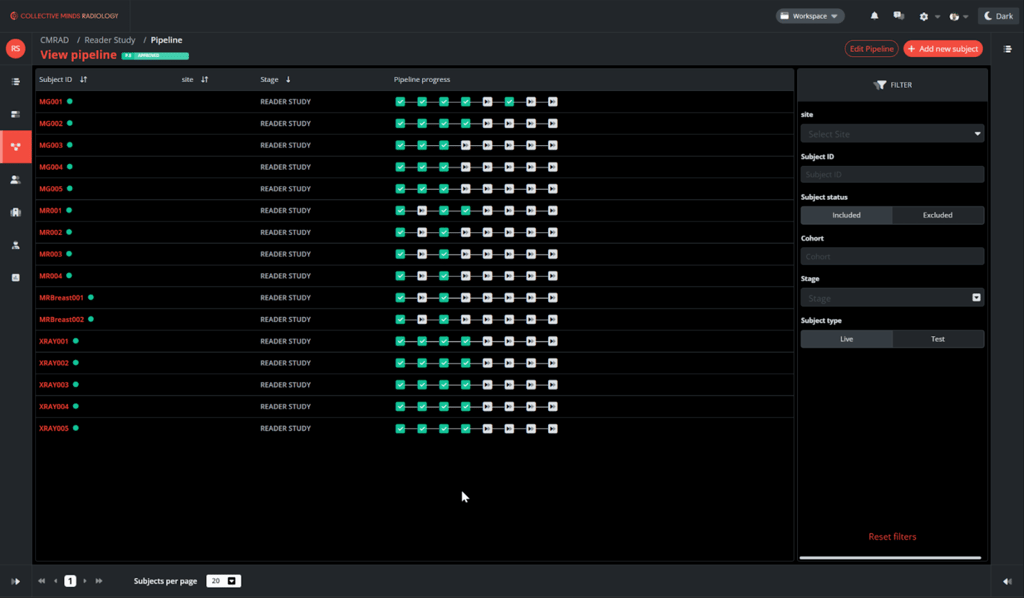
Collective Minds addresses these challenges through the Collective Minds Research platform, which is built around the specific failure points described above rather than around imaging in the abstract. Acquisition protocols and site qualification are enforced through the platform rather than relying on a PDF imaging manual, so drift across scanners and vendors is caught before it becomes a pattern. Quality control runs as studies arrive, not weeks later at central review, which is what makes a same-visit rescan possible instead of a permanent data gap.
Reader and adjudication workflows are managed with defined rules, automated routing, and full traceability, so disagreements move through the queue on a predictable schedule instead of building up before a milestone. Imaging data is structured so it reconciles cleanly with the rest of a trial's clinical data instead of needing manual cross-checking by a statistician after the fact. AI tools can be plugged in alongside manual review, with the reader retaining final say over any AI-assisted measurement, keeping the workflow auditable end to end.
None of this removes the need for a well-designed imaging plan and trained readers. It removes the operational failure points that turn a well-designed plan into a messy dataset once it meets real sites and real patients.
Also Read: Medical Imaging Workflow: Optimize Clinical Trial Success

Medical imaging challenges are manageable with the right infrastructure
None of the ten challenges above are unusual or unexpected. They show up in most imaging-heavy trials to some degree, and the trials that handle them well are not the ones with the fewest problems. They are the ones that planned for these failure points before the first site was activated, with an imaging plan, a quality control process, and a data pipeline built to catch issues early rather than at database lock.
The common thread across all ten challenges is timing: every one of them is cheaper and easier to fix the earlier it is caught, whether that means catching an acquisition error the day a scan is uploaded, catching reader drift mid-study instead of at final analysis, or catching a data reconciliation gap in the design phase instead of after enrollment closes. Infrastructure that surfaces problems early does more for data quality than any amount of retrospective cleanup.

Reviewed by: Pilar Flores Gastellu on September 9, 2026